> ## Documentation Index
> Fetch the complete documentation index at: https://docs.isomorphic.sh/llms.txt
> Use this file to discover all available pages before exploring further.
# Introduction
> A team knowledge base that lives in a GitHub repository, and that Claude, or any MCP client, can search, read, edit, and render as an interactive app inside the conversation.
Your knowledge is markdown in a git repo you own. Isomorphic is the layer that lets an LLM
maintain it: a Model Context Protocol server with a librarian's toolkit, a content index that
keeps reads fast at any size, computed views, and an in-client viewer and WYSIWYG editor so a
non-technical teammate never has to open GitHub.
 Connect Claude to the hosted service and create your first brain.
Run it yourself, from a folder on your laptop to a multi-tenant deployment.
How a tool call travels through the system, file by file.
The setup that lets Claude Code write most of this codebase.
## Try it in two minutes, with no accounts
```sh theme={null}
git clone https://github.com/isomorphic-team/isomorphic-app
cd isomorphic-app && pnpm install
pnpm try ~/Documents/notes # any folder of markdown; an Obsidian vault works
```
The real MCP server, the real librarian tools, and the real content index, against a git
repository on your disk. No GitHub account, no Cloudflare account, no tokens. Connect it
with `claude mcp add --transport http isomorphic-local http://127.0.0.1:8788/mcp`, or open
`http://127.0.0.1:8788/b/local/notes` in a browser for the same viewer and editor with no
MCP host at all.
## Why not a folder of markdown and a coding agent?
You can point Claude Code at a folder of notes today, and for one person that is a fine place
to start. Isomorphic is for what goes wrong after that:
* **Moving a page breaks every link to it.** `move_page` repoints each inbound link, markdown
and wikilink alike, in the same commit. `delete_page` tells you what still points at the page.
* **An agent rewrites a whole page to change one paragraph.** `write_page` takes exact
find-and-replace edits and appends. An anchor that matches zero or several times aborts the
whole call, so a batch is never half-applied and a page is never silently clobbered.
* **Reads stop scaling.** A derived content index keeps search, backlinks, validation, and the
graph to one or two queries on a 3,000-page brain, and checks the branch HEAD on every read so
an edit made on github.com or by another agent is never served stale.
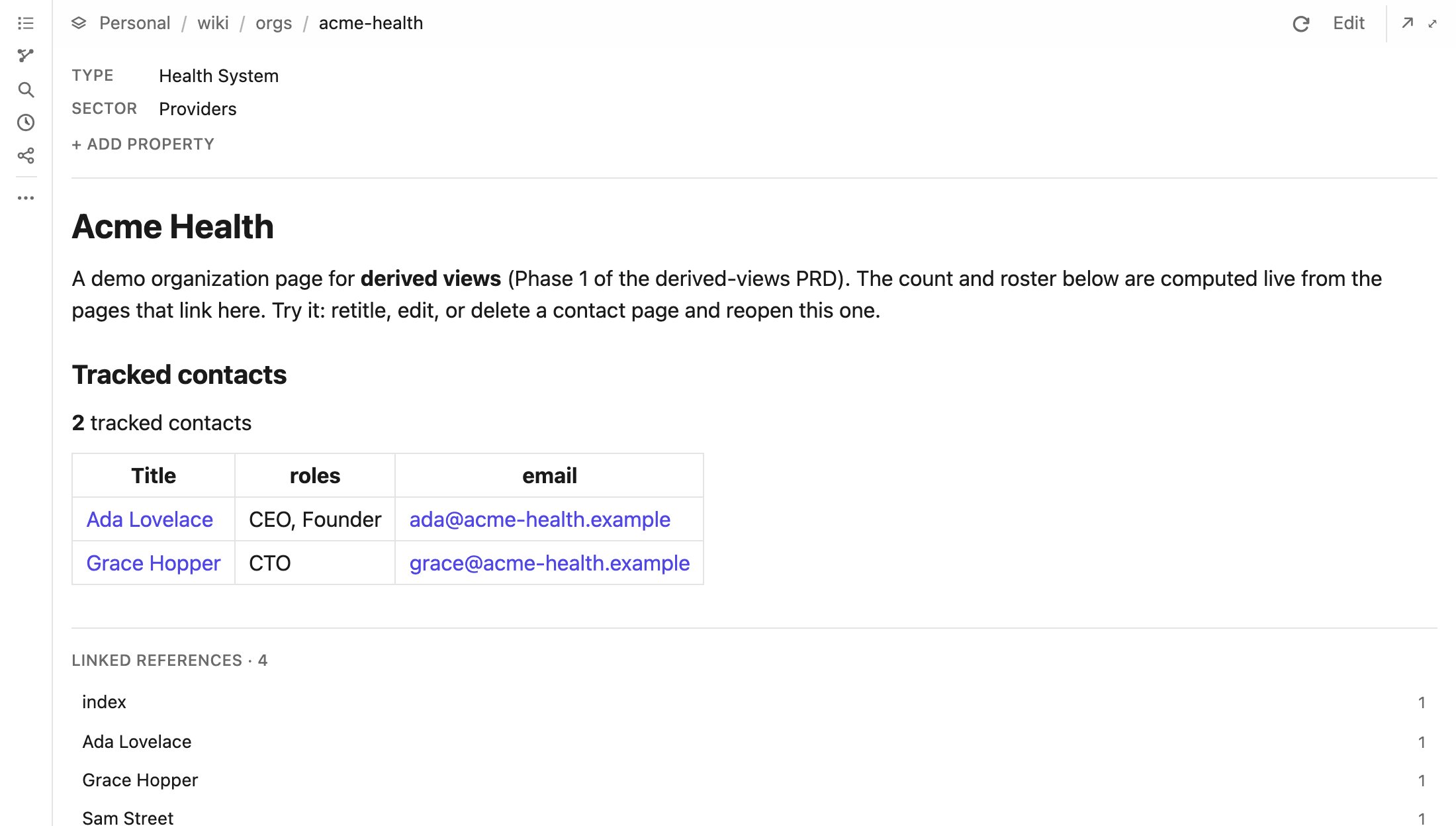
* **Listings drift.** A fenced `okf-view` block is a listing, table, or count computed from
backlinks or frontmatter, recomputed on every read instead of maintained by hand.
* **Half the team will never open a terminal or GitHub.** The viewer and editor render inside
the conversation and in a browser tab. Teammates sign in with an email link, nobody needs a
GitHub account, and orgs, roles, invitations, and per-brain sharing are all built in.
## What works where
The server never calls a model. It is an MCP server; the client brings the model, and any
client that speaks the protocol works.
| Surface | Works with |
| - | - |
| **The tools:** search, read, write, move, validate, computed views, import, brain-authored tools | Any MCP client over Streamable HTTP, with OAuth 2.1 or a bearer token: claude.ai, Claude Code, Claude Desktop, the MCP Inspector, and anything else that speaks MCP. |
| **The in-conversation app:** viewer, WYSIWYG editor, file tree, graph, activity, roster | Hosts that implement the [MCP Apps](https://modelcontextprotocol.io/extensions/apps/overview) extension. claude.ai renders it, and so do the MCP Inspector and VS Code Copilot. In a host without it the tools still work and return text. |
| **The same app in a browser tab** | Any browser, no MCP host: `/b///` on a multi-tenant deployment, signed in with the same email link, and `/b/local/` from `pnpm try`. |
| **Reading and editing the brain itself** | Anything that reads markdown: github.com, Obsidian, `grep`, a pull request. The brain is a plain git repository and needs none of this software. |
## Why this exists
Writing knowledge down is a separate job from doing the work, which is why it does not get
done. LLMs are good at that separate job and bad at doing it into a database whose shape they
cannot see.
So the substrate is one markdown file per concept, in a normal git repository, in the
[Open Knowledge Format](https://github.com/GoogleCloudPlatform/knowledge-catalog/blob/main/okf/SPEC.md).
You can read it on github.com, edit it in Obsidian, grep it, diff it, and review a change in a
pull request. If you stop using Isomorphic tomorrow you still have everything.
Open source under [AGPL-3.0-only](/licensing). Run it, fork it, deploy it for your own company,
sell services around it. If you modify it and let others use your version over a network, you
owe those users your changes. Your knowledge base is your data and the license does not reach it.
This documentation is built and hosted on [Mintlify](https://mintlify.com), a developer documentation platform.
Connect Claude to the hosted service and create your first brain.
Run it yourself, from a folder on your laptop to a multi-tenant deployment.
How a tool call travels through the system, file by file.
The setup that lets Claude Code write most of this codebase.
## Try it in two minutes, with no accounts
```sh theme={null}
git clone https://github.com/isomorphic-team/isomorphic-app
cd isomorphic-app && pnpm install
pnpm try ~/Documents/notes # any folder of markdown; an Obsidian vault works
```
The real MCP server, the real librarian tools, and the real content index, against a git
repository on your disk. No GitHub account, no Cloudflare account, no tokens. Connect it
with `claude mcp add --transport http isomorphic-local http://127.0.0.1:8788/mcp`, or open
`http://127.0.0.1:8788/b/local/notes` in a browser for the same viewer and editor with no
MCP host at all.
## Why not a folder of markdown and a coding agent?
You can point Claude Code at a folder of notes today, and for one person that is a fine place
to start. Isomorphic is for what goes wrong after that:
* **Moving a page breaks every link to it.** `move_page` repoints each inbound link, markdown
and wikilink alike, in the same commit. `delete_page` tells you what still points at the page.
* **An agent rewrites a whole page to change one paragraph.** `write_page` takes exact
find-and-replace edits and appends. An anchor that matches zero or several times aborts the
whole call, so a batch is never half-applied and a page is never silently clobbered.
* **Reads stop scaling.** A derived content index keeps search, backlinks, validation, and the
graph to one or two queries on a 3,000-page brain, and checks the branch HEAD on every read so
an edit made on github.com or by another agent is never served stale.
* **Listings drift.** A fenced `okf-view` block is a listing, table, or count computed from
backlinks or frontmatter, recomputed on every read instead of maintained by hand.
* **Half the team will never open a terminal or GitHub.** The viewer and editor render inside
the conversation and in a browser tab. Teammates sign in with an email link, nobody needs a
GitHub account, and orgs, roles, invitations, and per-brain sharing are all built in.
## What works where
The server never calls a model. It is an MCP server; the client brings the model, and any
client that speaks the protocol works.
| Surface | Works with |
| - | - |
| **The tools:** search, read, write, move, validate, computed views, import, brain-authored tools | Any MCP client over Streamable HTTP, with OAuth 2.1 or a bearer token: claude.ai, Claude Code, Claude Desktop, the MCP Inspector, and anything else that speaks MCP. |
| **The in-conversation app:** viewer, WYSIWYG editor, file tree, graph, activity, roster | Hosts that implement the [MCP Apps](https://modelcontextprotocol.io/extensions/apps/overview) extension. claude.ai renders it, and so do the MCP Inspector and VS Code Copilot. In a host without it the tools still work and return text. |
| **The same app in a browser tab** | Any browser, no MCP host: `/b///` on a multi-tenant deployment, signed in with the same email link, and `/b/local/` from `pnpm try`. |
| **Reading and editing the brain itself** | Anything that reads markdown: github.com, Obsidian, `grep`, a pull request. The brain is a plain git repository and needs none of this software. |
## Why this exists
Writing knowledge down is a separate job from doing the work, which is why it does not get
done. LLMs are good at that separate job and bad at doing it into a database whose shape they
cannot see.
So the substrate is one markdown file per concept, in a normal git repository, in the
[Open Knowledge Format](https://github.com/GoogleCloudPlatform/knowledge-catalog/blob/main/okf/SPEC.md).
You can read it on github.com, edit it in Obsidian, grep it, diff it, and review a change in a
pull request. If you stop using Isomorphic tomorrow you still have everything.
Open source under [AGPL-3.0-only](/licensing). Run it, fork it, deploy it for your own company,
sell services around it. If you modify it and let others use your version over a network, you
owe those users your changes. Your knowledge base is your data and the license does not reach it.
This documentation is built and hosted on [Mintlify](https://mintlify.com), a developer documentation platform.